The writing prompt was Things that we’ve lost to Technology
Sign on the Dotted Line
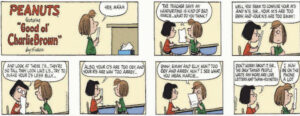
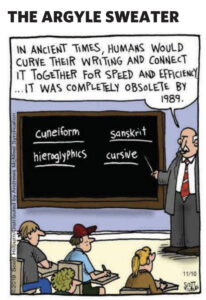
When I was young, everyone was taught how to write in print and cursive. These skills were crucial to our lives moving on. As part of that training, we were taught and had to practice signing our names in cursive writing.
There were manual typewriters at the time, but not everyone’s family had one. They had these crazy keys arranged in a very strange way, as they did not follow alphabetical order. What the heck is a ‘qwerty’, anyway? You needed instruction to figure it all out. Touch typing was not introduced to us until much later in our schooling. For me, it was in Junior High School. It was a little easier for me since my mother had a secretarial typing book to learn from, although, as far as I know, she never learned how to type or worked as a secretary. I decided to teach myself on my father’s typewriter (I never actually saw him typing either). I followed the fingering in the book and practiced on the passages included, timing myself with a kitchen timer. The Junior High School class helped reinforce and encourage me to continue what I was doing at home.
But you couldn’t use a typewriter to sign your name to documents. You could type letters and print your name at the end of them, but there was always a signature required, between the “Sincerely yours,” and “your printed name,” to prove that you were the author of the writing. Nowadays, they would call that two-factor identification.
Here’s an example of my signature when I was 12 years old. It was taken from one of my 1960s textbooks, where I also doodled and signed my name.
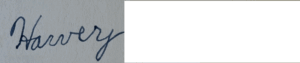
My first official document that I remember signing was when I got my Social Security Card at 16 years of age:
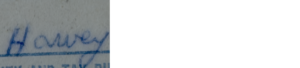
My handwriting did occasionally look a little off. When I graduated from High School, my diploma read “Harvey O. Heilbrun.” Clearly, my high school chose to use my signature as the model for my name, rather than the name listed in their permanent records, which had a middle initial of D instead of O. I simply told everyone that Harvey O’Heilbrun was my Irish name.
In college, I chose to print more than to write in cursive. I could print faster and more legibly than I could write in script. And in college, there were a lot of notes to take by hand.
Our signatures became much more important when we became adults and entered the workforce. We were now signing documents – licenses, bank withdrawal slips, mortgages, and charge slips. In a lot of those cases, your signature on a document had to match the signature that you had on other official documents, such as your driver’s license or passport.
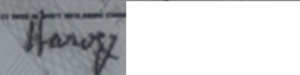
My cursive handwriting has remained largely unchanged, except that I tend to run the “brun” of my last name, making the last letters sort of flow together into a line. I’ve never quite been able to get the b to r to u to n letters written well, and it’s a lot easier this way.
Now, we come to our present day, where photo IDs are the required norm. Signatures have become a thing of the past. My bank has my signature on record, but when they request that I sign for a withdrawal or other bank transaction, I must use a pencil with a thick, rubber, blunt point to write on a screen.
When I have to sign for a prescription at the drug store, I’m asked to use my finger. Neither of these produces a fine line of writing. They become a blurry blotch of something, where you might recognize a letter or two, but none of them match my signature. You don’t even have to use your real name. You can write anything down on that device, and it accepts that you are who you claim to be. And, many people do just that.
Here is the signature that was accepted at a bank when I set up a new account this week:
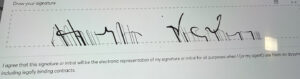
WTF!
We have the technology to write on these machines with precise control.
Here’s my signature using my Apple Pencil on my iPad.
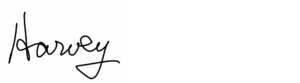
Granted, Apple pencils are proprietary to Apple devices. However, here’s my signature, created using an Adonit Jot Pro, which is compatible with any device. 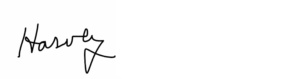
The technology is there, so why not use it? Our signatures were very important when we used to vote. The election officials would match our signatures against those in their voter registration book.
A picture may say a thousand words, but unless you are updating your picture frequently, trust me, your face does not stay the same. Signatures take a lot longer to change, plus, you can make your signature the same as you originally signed things by just concentrating while you are signing. Try to do that with your face.
Cursive writing is still taught in schools. In my district, it begins in 3rd grade. Let’s try to make it more meaningful.