M – What are you? A lesson in morphing.

What if you could morph into something else?

If you’re a fan of the new Supergirl TV show (or a DC Comics fan) you know there is a character on it called J’onn J’onzz. He is a martian and one of his abilities is to be able to transform himself (or morph) into someone else.

There was a TV show on in the 1980’s, Manimal where the main character, crime fighter Jonathan Chase, could morph into any animal.

There are a number of online apps and computer apps that allow you to take two pictures and have them morph into one another.

Click here to watch me change into an owl: https://goo.gl/eqA5iP

Then there is a podcast I listen to “The Icebox Radio Theater” where there is a character in one of their broadcasts, Mustard Girl, who has the ability to morph into any object.

So what would you like the ability to morph into? Personally, I would like to have a combination of all three of them, with more of an emphasis on animals and objects. You’ve heard the idiom “be a fly on the wall”, in reference to how you could overhear a conversation. With those abilities, you could actually be a fly on the wall. As a fly, you risk being swatted, so maybe “a book on the shelf” or a “bulb in a fixture”. Do you think my students would notice an extra desk or chair in the room when they think no one’s watching?

Granted, this can get to be a bit creepy and invasive, but it sure would be fun. Imagine being out in the country and just morphing into a horse or in the sea and morphing into a dolphin just to roam free.

Right now I think I’ve written enough for today, so what if I just morph myself into a pillow and take a nap.

Posted in A to Z Blog Challenge 2017, Writing | Tagged | 1 Comment

L – Liar, Liar, Pants on Fire!

What if lying caused some physical changes in you?

We all know the story of Pinocchio. The wooden boy who wanted to become real. His major handicap, in that quest, was that whenever he told a lie, his nose would grow. Telling the truth would return it to its original size. Having some sort of indicator that you are telling a lie, in this case, helped Pinocchio realize some of his faults so that he could correct them. The end result, he becomes human, which is interesting in itself, for I know of no human who hasn’t lied at one time or another. But what if in reality, some physical changes did occur in you when you lied?

There are two ways to explore this. In the real world, what are the ways we already physically change when we lie, and in the fantasy world, similar to Pinocchio, what physical changes would seem appropriate to happen to you?

In the real world, there are already established practices and theories that can detect when you are lying.  The most popular one is the lie detector (or polygraph machine) test. If you’re like most people, lying makes your heart race, you pant, your blood pressure increased, and you drip sweat. A polygraph machine detects lies by looking for signs of these physiological changes

Another way to detect lying is through neuro-linguistic programming. (https://goo.gl/O6Ek5C) This is considered by some a pseudo-science, but people do believe in it. The gist of it is that your body is programmed to show where your thoughts are coming from. The window to those thoughts is through your eyes. By watching someone’s eye movements while they are talking, you can determine if the words they are sharing with you are actual recollections, or invented stories; whether they are auditorily remembered, visually remembered, kinesthetically remembered (touch, feel, smell), or there is internal dialogue that is occurring as they speak.

The eye movements are very subtle and you really have to know what you’re looking for in order to see. Check out this one minute video: https://www.youtube.com/watch?v=2hF5Vh3gvpU 

Both of these methods are defeatable if you are aware of what they do and you are trained to subvert them, like I guess some spies are.

What would be more interesting would be the Pinocchio scenario. Imagine that whenever you lie, there is a physical growth or shrinkage to a part of your body that is directly connected to the lie.

“You’ve been lying through your back teeth again.”

You start a rumor and either your tongue or ears begin to grow. You lie about stealing something, your hands grow. You lie about some abuse or sexual exploit and certain parts of your body would begin to shrink. Use your imagination.


Maybe your nose, similar to Pinocchio, can be the default organ of growth, for those lies that don’t fit into any category. The bigger the lie, the more intense the physical reaction.

The downside of any of this is that there are times we lie purposely to protect people. Someone just died and you want to hold off telling someone until after their birthday. You don’t want to ruin the image of a person to an infant, like their father or mother are bad people.  And there are just lies that are accepted, because we know the truth will out itself eventually with no real harm being done. Think of Santa Claus, the Easter Bunny, and the ghost that lives in my house that always hides my keys, so that I can’t find them.

The plus side is being able to see when someone is trying to deceive you. Picture if you will what politicians, car salesmen, repair people and for you teachers out there, some of your students, would look like. I can just imagine!

Remember mood rings. Those rings that changed color supposedly based on your emotional state. What if they could also be made to detect lying? Would you be as willing to purchase them like you did when they only showed moods?

Posted in A to Z Blog Challenge 2017, Writing | Tagged , | 7 Comments

K – I kid you not!

I start this off with a disclaimer – The following blog entry has no direct connection to any desire I have or have ever had. I love my wife and son, with all my heart, and have never had any second thoughts or desires in my life, to not have them part of it.  I wouldn’t want my life to be any different than it is today.

What if I never had kids?

Having kids is an important part of the continuing of a species. Watching them develop, as they grow up, enriches our lives and helps us become better, more compassionate, and empathetic individuals. I wouldn’t have it any other way. But…what if we went through our individual lives and had no kids? To speculate on this, I have it a little easier than some parents, as I only have one child. So as I share my thoughts, I realize that there are those of you with multiple children, whose lives are different from mine, and whose experiences would have more ramifications had you no children to begin with. I also acknowledge that there are those of you that already have no kids, either by choice or misfortune. I leave it to you to write about the what having kids would be like.


I had been married for 3 years when my son was born. The day he was born, my life, as I knew it, changed. I now had a family. Someone to nurture and protect with the help of my wife. My wife ended her job so that she could stay home for a while and raise our son. As she went back to work, we had to find temporary caretakers of this being. The money that I had been putting each paycheck into IRA’s and such had to be decreased and stopped, so we could afford enough to continue living as we were accustomed to with this added mouth to feed and clothe. There were new concerns about everyone’s health and welfare that added to our daily anxieties and stress. Thankfully, so far, everything is working out.  

But if we didn’t have kids, a lot of these changes would not have occurred. The direction our lives would have taken would have been different. Since we both wanted to have a child, the stress and fears of not being successful at achieving that goal would have remained. That, at some point, would have had to resolve itself eventually, probably due to our ages.

If we had decided not to have children, to begin with, then our careers would probably have become more of a priority and the continuance of saving some money for our retiring years. My wife and I enjoyed dancing at Folk music events that were held locally, which is where we actually met (see http://www.hdhstory.net/Storyblog/?p=402). We eventually stopped going, since we had a child to take care of and also our interest in dancing waned. Without a child, we would have probably kept up the dancing and the concerts.


We would have probably traveled a bit more. My wife likes to travel. Hopefully, work pressures and vacation days would have been used more effectively (I don’t like to plan).I think the locations of the vacations we took, which involved travels to mountains and lakes, would have probably remained the same. However, the ones to Legoland and zoos, might not have occurred. If anything more trips farther to the south and midwest might have been on our plate.

I might have continued to teach beyond the first year I was eligible to retire. A family insurance package I accepted to retire, might not have been as high a priority as staying in the field and increasing my income. Of course, not retiring when I did, would have changed my career choice. I wouldn’t have pursued an advanced certificate in Educational computing, which wouldn’t have provided me with as many opportunities to learn and teach more about technology, which I really like doing now. Also, I would not have followed my desire to tell stories publically. I would still be limited to just telling in my school system.  

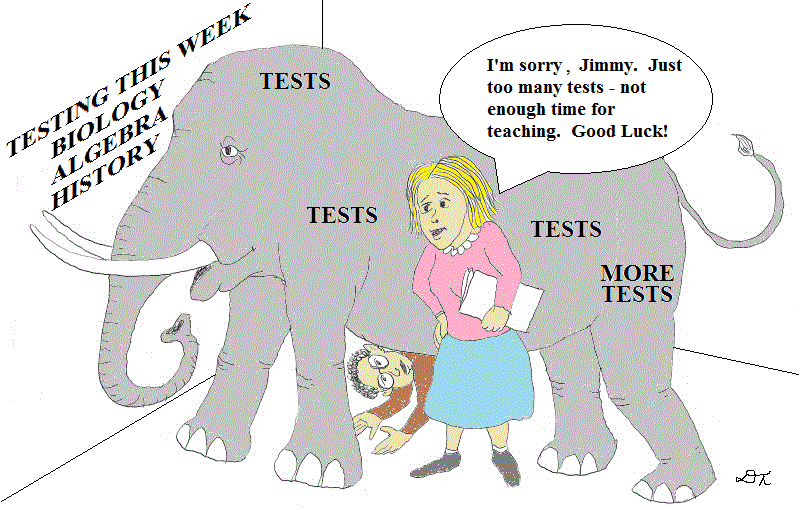
If I were to guess, I would be less of the teacher I was, for two reasons. One is the experience that I gained as a parent gave me more credibility when giving my teacher strategies to other parents. Most of the parents I dealt with accepted my wisdom, which I had gleaned from having taught many years. There were those few that took my advice and observations of their children as one who had no experience with having his own children. It is a dilemma that some young, unmarried teachers have, which I would assume would be magnified, the older I got. The second reason is the direction that education has gone, with common standards, more mandates, and less time to actually do some of the things that I had been doing throughout my career (see http://www.hdhstory.net/Storyblog/?p=291) I think that the stresses of the job would have made my life much less fulfilling.

My writing would be much more school focussed, as that was the only topics I wrote about during my teaching days.

Think of all the children’s television shows and video games I would not have been introduced to.

And the friendships that I have gained over the years might be different, due to possibly traveling more and certainly I wouldn’t have met my daughter-in-law and her family, which would have been a great loss, though I wouldn’t have known it.

The biggest difference I think would probably becoming more of an adult, looking at life through adult eyes, more serious, not as silly and not having as much fun as I did growing up with my child.

I feel sorry for the me, who never had kids, in that parallel universe, though it would be interesting to meet him and see where he’s been. What if there was a way to meet the parallel you? I can just imagine! (But I already did that letter.)

Posted in A to Z Blog Challenge 2017, Personal Stories, Writing | Tagged , | 5 Comments

J – Junk, what a waste!

What if you didn’t want to get rid of all your junk?

According to Dictionary.com, the definition of junk is:

  1. any old or discarded material, as metal, paper, or rags.
  2. anything that is regarded as worthless, meaningless, or contemptible; trash.

Our houses are full of it: bottles, cans, pieces of wires, old toys, fixtures, boxes, etc. Add to that old toys, albums, books, magazines, and personal items, and the piles can get very big.  The question to ask is what do you do with all of this junk? The simplest solution…Throw it out!

Easy to say…harder to do. Some things have sentimental value only to you, others serve no purpose in their present state (but if altered?), still others are pieces of your own history, and some are just plain garbage.

Garbage you can probably throw out. A lot of the stuff you can recycle or if you are really creative you can turn everyday objects into other useful things such as new games or artwork.


When I was teaching 5th grade we took students to a recycling center to see how it operated. One of the projects that students had to do for me was to repurpose some of this junk. Here are three examples of the things they created.

     A marionette,                             a checker game,                             and a bowling set.  


I was very impressed with the creative thought put into all the things that my class produced. Of course, over time, these new things created will fall into disuse and return to the “Junk” category, unless they become reclassified as sentimental items or part of your history.

I’m a storyteller. The hardest things for me to part with are the things that are part of my story. My old school notebooks, some of my teaching material and work from my students, things that I’ve written, either when I was a kid or now. Some of the things that tell my history only tell my history if you want to do some digging. My pocket calendars and checkbook registers share some of the lifestyle I led. Where I spent my money. What events occurred that I was involved with. Combine some of those events, checks, and writings that I’ve done and you get a picture of my life.

At some time in my life, I know I will have to downsize my collections. My recourse will be to make and keep electronic copies of some of my collections. Scan those old papers, and notebooks, maybe all of the meaningful birthday, and anniversary cards I’ve held onto. Make a digital keepsake that only takes memory not space. It may mean only something to me, or possibly something to pass down to future generations to know who I am.

But in the end, it will go where all junk goes…away.

Now here’s a thought:  What if someone was willing to start a Kickstarter project to create a junk repository of personal histories?

Posted in A to Z Blog Challenge 2017, Writing | Tagged , | 4 Comments

I – Imagine that!


What if you could see your imagination?

Imagine you are closing your eyes right now. Now visualize yourself on a beautiful pristine beach. It is a pleasant sunny day, yet not too hot with a light breeze.

You feel the warm sun warming and energizing your skin. You hear the waves gently lapping on the sand.

You are completely alone on the beach and feel completely safe. You reach down and take your shoes and socks off and place them on a towel on the sand. The grains of sand feel warm and energizing on your feet as you walk along the sand. You hear the faint sound of seagulls in the air…

This is the beginning of a meditation guided script. If it is successful you see in your mind a picture that only you can connect to. It may be a beach near you. It may be one that you visited long ago. In may be an unknown beach that is be created by your mind as the scene is being described to you.

Leaving the meditation behind look at what your imagination is doing. It is creating a picture or a story. It creates a movie of an experience you’ve had, one you wish you had, or one that is just an invention of your mind.

There are studies you could search for on the web to explain what parts of the brain are active when you imagine. What mental workspace is being created in your head? Which conditions are optimal for helping you imagine things There are theories about how imagination helps us, makes us more creative, improves learning, and motivates us to do things.

But what I’d like to pursue, is what if we could see our imagination? Not just in our heads, but outside our physical being. Think about what it would be like to see your imagination at work on a TV screen. “Hey, I just came up with a new idea. Let me show it to you.”

Think of how much easier it would be to manipulate the scenes that you are seeing in your head if you could send them to a piece of paper and then be able to write, edit, revise right on that paper and the scene would change similar to the guided script’s scenario.

When I write songs, I imagine a tune, usually when I’m sleeping. If I’m lucky I’m near a recorder where I can record the tune; I get up and record it so that I don’t forget it. See http://www.hdhstory.net/Storyblog/?p=41. From there I have to imagine lyrics that would go with the tune, and think of a theme that goes along with it. It would be so much easier if I could just imagine me singing the song and then be able to transfer it directly to a screen where I can watch my imagination’s finished product.

There are some negative consequences to being able to see your imagination. Remember the advice for public speakers who have fear of speaking to an audience in public, “Just imagine that the audience is all sitting there naked”. If that video or picture popped up during your speech or performance so that others could see it, it could be problematic. And then there are other fantasies that you might imagine, following movies, books, or just desires that you might not want people to see.

If we had the ability to see our imagination, I would hope that we had some control over what we see in public viewing and those that we keep in our heads; sort of like a mental mute button. Imagine how you would use that skill. That would definitely be cool.

And what if you could read other people’s imaginations and thoughts. That might be something to explore in another blog. Think about it.

Posted in A to Z Blog Challenge 2017, Writing | Tagged | 2 Comments

H – Hockey – Let’s play the game!

What if Hockey was played without any fighting?

My favorite sport is ice hockey. I got interested in hockey when I was 10 years old. My future brother-in-law got me hooked on the game. He was a big New York Rangers fan, had season tickets, and would take me to games occasionally. At age 15 I started playing at a local ice skating rink, learning the hard way that elbow guards would be a good investment and ice was hard. I played intercollegiate club hockey when I went to college at Stony Brook University from 1968-1972. After college, I played a few pick-up games for a year or two and one final alumni game when I was 52. My allegiance which originally was to the Rangers, switched to the New York Islanders when I started college on the Island and then moved there. One of my favorite Islander players, Chico Resch, ended up playing for the New Jersey Devils, so my allegiance nowadays is shared between the Islanders and Devils, with the Islanders being the preferred favorite.

I digress. As I stated, ice hockey is my favorite sport. If you’re a hockey fan, then you’ve probably heard the saying, “I went to a fight one night and a hockey game broke out.” Fighting is pervasive in National Hockey League (NHL) play. Having played hockey, I’ve experienced the high intensity of the game, the adrenaline rush, and the occasional lack of control. When I was playing in college, they followed NHL rules, meaning that fighting was allowed.

———————————-

Some history: Fighting was part of the play of the game for many years until the NHL in 1922 introduced Rule 56, which formally regulated “fighting” or “fisticuffs” as it was referred to in the NHL rulebook. Instead of ejecting a player from the game, the player was issued a 5-minute major penalty.

In contrast, players fighting in international or Olympic hockey receive a match penalty and are ejected from the game.

Even now, in Division I and Division III National Collegiate Athletic Association (NCAA) hockey, the fighters are given a Game Disqualification, which is an ejection from the game and a suspension for as many games as the player has accrued Game Disqualifications during the course of a season.

——————————————

So why can’t the NHL adopt a similar rule?  They won’t. It’s part of the game they say. So much a part of it that not only does television broadcasts of games show you the fights, but also replay them for you. In my opinion, the first step needed is for the television to stop showing the fights when they occur. You can comment about what is going on, but don’t showcase it. Fans will be upset, but eventually, players will have to realize that they are not being spotlighted for errant behavior. Once it becomes less public, the NHL might become more inclined to make more drastic consequences for fighting. Teams could look for more skilled players to take the place of “Enforcers”, those players that have less skill specifically put in games to wreak havoc.

If you’ve ever watched Olympic hockey where players are not permitted to fight (not to say that some fights don’t occur), where the rink is wider and there is more space behind the net, you’ll find some exciting hockey. Now you are looking at skill. You are looking at a very fast paced game, with fewer stops for useless brawling. That’s the way ice hockey should be played. WAKE UP NHL!

Once we have taken care of hockey, What if we could stop all of the dives and theatrics in professional soccer games? Let’s work on one sport at a time.


Posted in A to Z Blog Challenge 2017, Writing | Tagged , | 3 Comments

G – Game On!

What if Games impacted real-life decisions?

Games play an important part of our lives. When we are young they teach us how to follow instructions. How to cooperate with others. Hopefully how to accept defeat as well as victory. Games get us to improve our bodies as well as our minds. There are many examples of positive gameplay and how games influence us. And for all you skeptics out there, that includes video games. If you doubt me, check out the TED Talk by Daphne Bavelier on your brain on video games:

https://www.ted.com/talks/daphne_bavelier_your_brain_on_video_games


Games clearly have a benefit for us all. As with anything though, they can be played to excess and have negative influences as well. There is plenty of research on that too.

But let’s step away from the discussion of playing games and their present impact on our well-being and let’s jump into the realm of What ifs…? What if games we played impacted our real-life decisions?

In Fiction, I’m reminded of the movie, “The Last Starfighter” (1984) where a teenager who excels at playing a particular video game, discovers that this game was actually produced to screen candidates as fighters in a galactic war.  He gets recruited and… well… go watch the movie. I thought it was good.


In the book  Ender’s Game by Orson Scott Card, a boy is being trained on computer battle simulations, to command a battle fleet fighting an enemy that once attacked Earth. (Or so he thought).

These fictional characters were making real life decisions as part of their gameplay.

In real life, organizations like NASA, the Armed Forces, NOAA (National Oceanic and Atmospheric Administration), to name a few, use simulation games to train people to do their jobs. Their game decisions don’t impact what they do at the moment of play, but do impact the experiences they have for when the real decisions need to be made.

All this is well and good but it’s time to get a little different. Let’s look at some of the games we play now or played as a kid, and see what decisions we have made in our adult life are possibly based on them. I’ll do this in the form of questions.  Think back to how you played and what you do now.

Did Monopoly impact how you choose to purchase things? Did you strive to purchase as many things as you could? Did you buy a lot of cheap things, or wait to buy expensive items, knowing that you’d make more money in the long run. Out of curiosity, how did all our present billionaires fare in Monopoly as kids?

How about our great war heroes? How did playing games like Risk and Stratego impact how they deploy their troops and where they chose to attack or defend? How did they secure their own flag or country? Or use spies?


And the Game of Life? Did it influence your path? What career you chose? Go to college? How many kids you had?  Did you become that millionaire?


Think of other games we played, not only board games. Hop Scotch?  Tag?  Hide and Seek? Jump rope? Kick the Can? Cops and Robbers? Hounds and Hares?

What would be the real life decisions we gleaned from those activities?

In reality, I don’t think playing those games had any influence on our lives in terms of life choices. But how close to our games is our reality?

For now, I want you to picture yourself as if they did influence you. Which game(s) would have been the most influential in your life and where would it have taken you?

Or What if it were the other way around and the world we are living in is just somebody else’s game?


Posted in A to Z Blog Challenge 2017, Writing | Tagged , | 4 Comments

F – I have no FEAR!

What if you had no fear?

A definition of fear is: to be afraid of (someone or something) as likely to be dangerous, painful, or threatening.

When we feel fear, the following happens to our body: The amygdala in the center of our brain sends signals to our autonomic nervous system (ANS). The ANS kicks in, suddenly our heart rate increases, our blood pressure goes up, our breathing becomes more rapid.  Stress hormones such as adrenaline and cortisol are released. The blood flows away from our heart and out towards the extremities, preparing our arms and legs for emergency action.

We all have our fears. Some fears are rational like the fear of bee stings, if you have a severe allergic reaction to stings or fear of growling animals that are acting erratically. Those fears keep us safe. Some fears are irrational such as believing all of your food is poisoned or that everything you own is secretly recording your every action (Though with smart phones, tvs and gps tracking, that might not be so irrational). These fears have greater underlying problems.  Some fears appear real as in phobias which are very real to the person experiencing them and also very debilitating.

Given all that,  what if we had no fears?

For people that are shy and not risk takers. Having no fear might be a benefit. It might get you to take more chances than you normally would and allow you to improve in things that you are weak in. It might help you become more creative. Where would most of the things that were invented be, if those inventors gave in to their fear of failure? Where would all the medical and technological breakthroughs be if people were fearful to go where no one has gone before? It would also help people that have phobias not be afraid of things holding them back.

Then again having no fears, might also work in the opposite direction, where people ignore real safety issues and do stupid things. I don’t have to look while crossing the street, no one will hurt me. I won’t get burned walking through that fire. I can stay out in the sun all day.

There actually are people in the no fear category right now and there are awards for them. The award is called the Darwin Award. These awards originating in Usenet newsgroup discussions around 1985. The Darwin awards were named in honor of Charles Darwin, the father of evolution. They commemorate those who improve our gene pool by removing themselves from it.  

Here is a story of a 2015 winner. A 24-year-old voter, trying to conceal his identity, appeared at his polling station with a bag over his head. That would be a plastic bag!! – http://www.darwinawards.com/darwin/darwin2015-01.html Clearly, fear of suffocation was not on the table. I should mention that Darwin Awards are awarded posthumously.

So a lack of fear can go both ways. Your task is to look at the fears you have. Are they real? Are they imagined? Are they perceived as real?  Once that is decided you need to decide is this a fear that should or should not be dealt with. “It is a healthy fear that keeps me safe”. Or, “It is a fear that I know is keeping me from succeeding or moving forward”, such as fear of flying, or fear of speaking in public. For those Darwin award candidates, so really stupid that fear is not an issue, enjoy your award, you have nothing to decide.

Once decided, then act on that fear. Adhere to it, try to overcome it, either by yourself or with the help of others (professional or not) and let it move you forward in health and safety,

And what if your fear is reading blogs? No problem, you can just this.


Posted in A to Z Blog Challenge 2017, Writing | Tagged | 2 Comments

E – Educational Professional Development – Time to change

What if Educational Consultants only worked every other year?

I’ve been a teacher for over 43 years. For 33 of those years I worked as a classroom teacher, computer support teacher, and teacher of the gifted and talented. Following my retirement, in 2006, I became an Educational Technology Consultant to schools and since 2014 a substitute teacher (or guest teacher, as I like to refer to myself as). I have had lots of experience with Professional Development (PD)

My first few years teaching I was part of the building of a Middle School. There were 7 teachers in 6th grade to start with. There was no required curriculum from the state, only recommended curriculum. We would meet for about 10 hours a week in order to design and plan our curriculum and how we were going to teach it. As the school became established, our meeting times decreased. Our PD opportunities increased as new curriculum (Latin-English Transfer Project) and new philosophies (Brain study and Cognitive Level Matching) became popular. We began to be pulled from our teaching duties more and more to meet with professionals and learn new things.

This increased throughout the years. After I retired, more and more consultants were brought into the schools to teach teachers how to teach. There was the math consultant, the Teacher’s College Literacy consultant, the new science programs, to name a few. As a substitute teacher, I really don’t mind those PD days, since that means more work for me. However, as a teacher, it just meant more time away from my class, more information that I had to take in and understand, and less time to just internalize what it was that I was being taught.

When I was a full-time teacher, I recommended to administrators on numerous occasions that we should take a moratorium on bringing in outside PD consultants for new things to learn.  Basically, I suggested giving teachers a year to debrief. My idea was that you spend a year with all your consultants and fresh ideas and new programs as you do now and then take a year off. During that off year, you let the teachers internalize everything that they have learned. They can practice that curriculum or those strategies in their classrooms. They can use their meeting times (far less than during the PD year) and share successes and concerns with what they learned. Come up with new strategies and improve the programs. Teachers are not stupid. Most of them didn’t get to be where they were without the drive to learn new things. Give them some credit. Given a year of practice and discussion with each other, the programs that they are adopting become better. The questions that they raise will lead to what resources and people they need to have come in and support the next year’s PD.

My guess, from an administrative and budgetary point of view, is that it will also save districts’ money by not having to pay out to big time consultants every year.

Nothing in this plan stops PD from happening each year, it just changes the format of it. It allows teachers to stay in their classrooms more (I’m willing to give up some of those jobs) and also builds a school community with a lot more sharing of ideas, management strategies, and problem solving. I think that creates and improves a very positive school climate.

Here’s another thought from an individual teacher’s point of view…What if schools brought back sabbaticals so individual teachers could get their own year of PD. But that’s another thing to consider.

Posted in A to Z Blog Challenge 2017, Education, Writing | Tagged | 3 Comments

D – Drea-ea-ea-ea-eam, dream, dream, dream

What if we could control our dreams?

When I want you in my arms
When I want you and all your charms
Whenever I want you, all I have to do is
Drea-ea-ea-ea-eam, dream, dream, dream
Lyrics from the song Dream by the Everly Brothers

(https://www.youtube.com/watch?v=tbU3zdAgiX8)

There is much information about dreams on the web. What scientists think cause them? What are the meaning of dreams? (think Freud). Can we manipulate them? Are they based on real happenings and desires, or just our brains having fun scrambling ideas in our heads? I’m not going to answer any of these. Most of the information that I want to share will be based on one article in Scientific American By Jordan Lite on July 29, 2010. Here’s the link if you are interested in reading the whole article: https://www.scientificamerican.com/article/how-to-control-dreams/

According to the article, the literal definition of a dream is “a narrative experience that occurs during sleep.” I’m sure there are other definitions including definitions of things such as daydreams. But I’m going to stick with that definition for now.

There are different types of dreams. One is the story that you create that is somehow connected to things you do. For instance, a problem you’re trying to solve, some particular content that you might be thinking about (a movie or book you’ve just experienced, a bad day at the office, etc.), or dreaming that you are in a dream (sometimes referred to as a lucid dream).
In terms of controlling your dreams, it depends on what type of dream you are having or want to have. Do want to solve a problem in real life? Are you having nightmares that are overwhelming you (called Mastery Nightmares) and want to stop them or make them less nightmarish (by creating a Mastery Dream)? Do you want to specifically dream about something or someone?

Here are some of the solutions that were recommended to try. I have not tried any of them yet as of this writing, so I’ll have to let you know sometime in the future, or through the comments on this blog entry if any are successful.

If you want to problem-solve in a dream, you should first think of the problem before bed, and if you can get a picture in your mind, hold on to it in your mind so it is the last thing in your head before falling to sleep.

Next, don’t jump out of bed when you wake up. Research seems to show that almost half of your dream content is lost if you get distracted. Lie there, don’t do else but try and recall the dream. If you can think of the emotions that occurred in the dream.

Often a simple photo you may have might be a trigger to help you dream of someone or something you want to dream about. The suggestion is if you used to have dreams of flying, find a photo of a human flying.

As to nightmares, try to rehearse in your head, while you are awake, the scenario in which you conquer whatever it is that you are being traumatized about. You can use other people to help talk you through this scenario. These mastery dreams seem to carry over into

DOGGIE DREAMS

helping you feel safer and even more healed in your daytime state.

So there are some techniques to try. Now take control of your dreams and good luck with them.

Then again, what if we can’t control dreams, but they foretold the future? I don’t want to think about that.

Posted in A to Z Blog Challenge 2017, Writing | Tagged | 5 Comments